The father behind a celebrated name
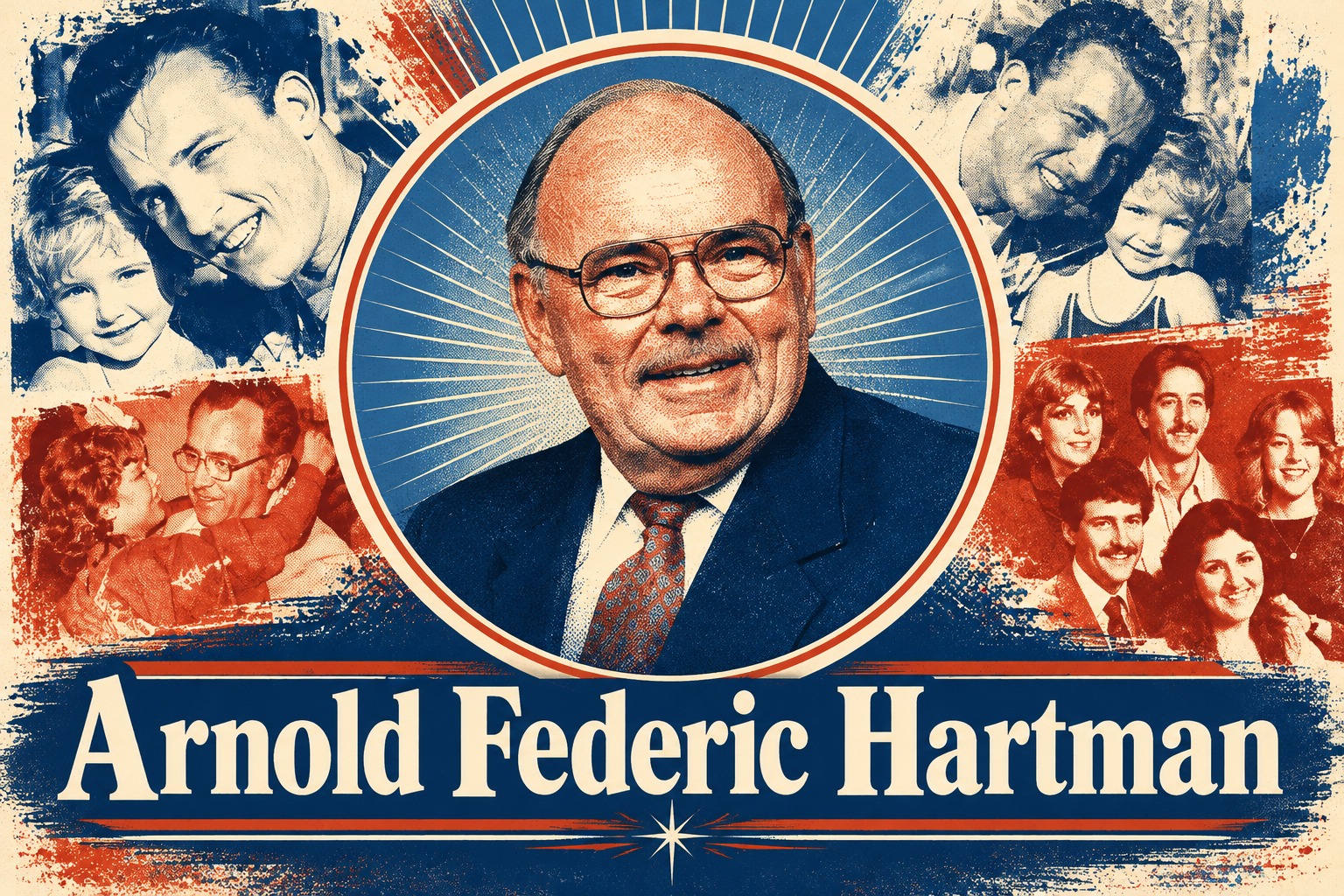
Arnold Federic Hartman is remembered chiefly as the father of Angélica María, the singer and actress whose career became a major presence in Mexican entertainment. His own life followed a less visible route through music, travel, marriage, and family. Born in Minnesota in 1913, he died in California in 1992.
I am drawn to the geographical breadth of that outline. Minnesota, Mexico City, New Orleans, and California are not merely distant dots on a map. They mark different chapters in a family whose work crossed borders before the daughter became a familiar face on film and television.
His name also appears as Arnold Frederick Hartman. The spelling variation should not obscure the central relationship: he was Angélica María Hartman Ortiz’s American father.
Minnesota roots and a changing surname
Arnold’s birth is dated January 16, 1913, in Dayton, Hennepin County, Minnesota. The family details supplied for his early life identify Herman John Wittenhagen and Lyla Pearl Farrier as his parents.
The difference between Wittenhagen and Hartman leaves an unanswered genealogical question. A change of surname can arise in several ways, but the circumstances in Arnold’s case are not publicly established. His childhood schooling and the origins of his musical training are similarly unclear.
What emerges more securely is an adult life associated with music and movement. He spent time in Seattle and later worked across the Americas. The broad trajectory suggests a working musician’s world, though it does not provide a complete itinerary or a list of ensembles.
Marriage to Angélica Ortiz
Arnold married Angélica de Jesús Ortiz Sandoval in Mexico City on November 24, 1943. She worked in theatrical production, placing the couple within overlapping entertainment professions. His music and her theatrical work formed the immediate background to their daughter’s early years.
Angélica María was born on September 27, 1944, in New Orleans, Louisiana. Her birthplace is an important detail in a biography so closely associated with Mexico. The family story already crossed the border before her career began.
I picture the professional connection here as a bridge between performance and production, while keeping its limits clear. Arnold and Angélica Ortiz traveled and worked in entertainment, but the names of every production, venue, or collaborator are not preserved in this account. Their marriage is better understood through its established milestones than through a reconstructed touring diary.
A daughter whose career grew in Mexico
Arnold and Angélica Ortiz divorced around 1949. Their daughter then lived in Mexico with her mother and entered entertainment as a child. The mother’s role in her early professional development became especially significant.
Angélica María’s later identity as La Novia de México belongs to her own long career as a singer and actress. It should not make Arnold disappear, but neither should it turn him into the architect of every success she achieved. His place is that of a parent with a musical background within a larger family and professional history.
The divorce also requires restraint. It establishes the end of a marriage and a change in the child’s household. It does not, by itself, prove permanent estrangement, an amicable separation, or a particular pattern of contact between father and daughter.
For me, the more interesting fact is that Angélica María’s family inheritance included an American father and a Mexican mother working in related creative fields. Her career developed from that mixed background into something unmistakably her own.
Later marriage and the wider Hartman family
Arnold later married Kathleen Maxine Craft. His later life is associated with California, including Canoga Park. This second marriage forms a separate chapter from the earlier partnership with Angélica Ortiz.
Names connected with the wider family include Linda, Kim, Derrick, and Lori, but the exact relationships and complete biographies are not consistently established in the supplied account. They should not be assigned detailed careers, marriages, or personal histories on the strength of a family listing alone.
One relationship is straightforward: Angélica Vale, born in 1975 to Angélica María, is Arnold’s granddaughter. That generational connection is direct even when accounts of Arnold concentrate almost entirely on his daughter. Vale’s own entertainment career extends the family’s public association with performance into another generation.
Music and business without a complete résumé
Arnold is described as a musician associated with the American Federation of Musicians. He is also called an entrepreneur. Those descriptions indicate more than one type of work, but a detailed business history is not publicly established.
There is no firm basis here for crediting him with particular films, naming an instrument as his specialty, or identifying successful companies. The absence of a long résumé does not mean he did no meaningful work; it means the available biography preserves family links more clearly than professional detail.
His finances remain equally uncertain. Neither a projected modern fortune nor an assumption of modest means can be justified from the facts provided. A touring career describes employment, not a balance sheet.
FAQ
Who was Arnold Federic Hartman?
He was an American musician and the father of Mexican singer and actress Angélica María. His name also appears as Arnold Frederick Hartman. His life spanned from January 16, 1913, to 1992.
Who was his first wife?
His first wife was Angélica de Jesús Ortiz Sandoval, a theatrical producer. They married in Mexico City in November 1943 and divorced around 1949. Their daughter, Angélica María, was born in New Orleans in 1944.
Angélica Vale is his granddaughter through Angélica María. Her place in the family should be distinguished from that of Arnold’s own children and from the relatives connected with his second marriage.
What is known about his later life?
He married Kathleen Maxine Craft and lived in California. He died in 1992. Detailed information about his later employment, assets, and private family arrangements is not publicly established.